
Bee's January 2026 Reviews
- Bee Wick
- Jan 23
- 9 min read
Updated: Jan 29
This will be less of a reading-over-break wrap-up and more of an end of 2025 recap (unlike Carys—go read her review as well), as I spent most of my winter break this year catching up on sleep and homework, and didn’t read quite as much as she did. I tend to pursue a very wide variety of genres (my bookshelves can attest!) when reading for fun, but the last few months have been especially diverse. I picked up both a short story anthology and a historical nonfiction text for the first time, and I really liked trying a genre different from what I’m used to as someone who mainly reads fiction.
Although I did read quite a bit in the last year, I didn’t end up finishing The Secret History by Donna Tartt—which I picked up to annotate and swap with Carys—but I’m about half way through and have had a great time, so expect a glowing review if the ending lives up to the rest of the book. I do hope that I can continue to read at a higher volume and write more in spite of the grueling IB coursework and upcoming tests, so look forward to more in the future if you enjoy this!
Lessons in Chemistry by Bonnie Garmus ⭐️⭐️⭐️½

Starting with the only historical fiction I read last year, Lessons in Chemistry by Bonnie Garmus is honestly not at all what I had expected it to be. The first exposure I had to this book was through the BookTok table at Barnes and Noble and its tacky cover that screamed badly written romance spooked me at first glance. The second exposure was the raving reviews from my parents for the TV series based on it. It’s safe to say these contrasting experiences confused me but I soon forgot about the dichotomy completely (I always forget about shows that are recommended to me). I only ended up picking it up later on a whim when I saw the newly gorgeous paperback cover and remembered that the contents weren’t necessarily what they seemed.
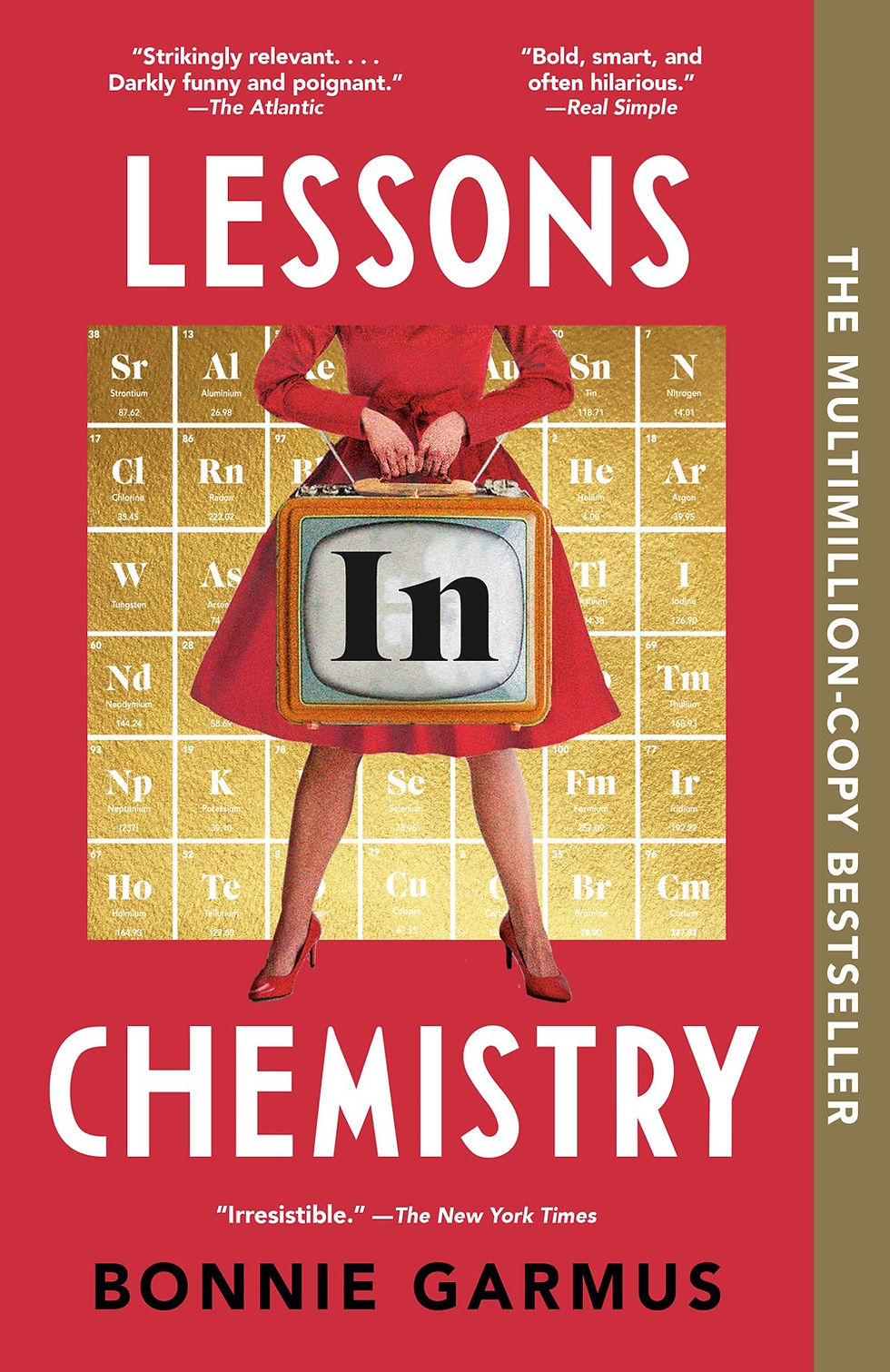
Lessons in Chemistry follows Elizabeth Zott, a female chemist in the 1960s at an all-male research lab, who is forced out of her position due to discrimination, leading her to take up a job as a TV cooking show host. What jumped out to me in the first chapter was the writing style, it has such a witty and wry sense of humor that only continues to endear itself to you through the rest of the book. Although I did enjoy it, the humor occasionally fell flat and cringy, and it was just something you had to accept. I think that the writing can serve the characters quite well, Elizabeth is very blunt and confident, and I do like how this comes across in dialogue and in her dynamic with Calvin Evans (a talented chemist at her research center and later her husband), but it can be too heavy handed at times, especially when she talks to other male characters. Her relationship with Calvin is definitely my favorite in the book, and I thought that both their personalities and dynamic were really well done, although this could just be because they were both written to match each other's intelligence and limited social skills.
I think that the main issue that this book faces is trying to preach about sexism too modernly for its context, both Elizabeth and Calvin are treated as so intelligent that they have a perfectly politically correct take on feminist issues although nobody around them has developed such an understanding. This is also played up so that every main male character other than Calvin is mildly evil or sexist and isn’t allowed to grow in any meaningful way.
The way that the author deals with the aftermath of certain events in the book (no spoilers!) gives it a very hopeful tone especially after the major twist. It is also really inspiring to see Elizabeth’s blunt defiance and matter-of-fact confidence in spite of what she went through, and I think that the best moments are when she tries to extend that to other women. Although the methods by which the author delivers messages and themes can be painfully excessive at times, my overall impression of Lessons in Chemistry was positive and I would definitely recommend picking it up.
Revenge by Yoko Ogawa ⭐️⭐️⭐️⭐️+½

If you are taking IB HL Literature (or have a friend in the class) then you most likely know about Revenge by Yoko Ogawa. When I heard the initial description of this book in this year’s syllabus I was very excited as horror tends to be one of my favorite genres and the unique structure of storytelling was very appealing to me. The setting reminded me of one of my favorite Japanese literary novels, Before the Coffee Gets Cold by Toshikazu Kawaguchi, and I was interested to read another in the genre. Revenge is a series of eleven unsettling short stories that all interconnect. The stories feature a wide cast of characters, all unnamed, that experience odd or slightly paranormal events in a very quotidian Japanese setting.
I tend to be pretty picky with horror books because I do read a lot of the genre, but this ticked all of my boxes. The short story format made it impossible to put down and created a very fresh feeling, with an atmosphere that was unlike anything I’ve ever read. I think that the unique mood is partially due to the setting, because I’ve only read English novels within the horror sphere; the Japanese conventions felt unexplored and unfamiliar to me. The techniques that Ogawa uses (scrutinized greatly with the help of Ms. Lewis) made it feel almost like a puzzle, the motifs and characters as clues, and the moments where I recognized connections felt like placing in the last jigsaw piece.
The only downfalls of Revenge are typical of translated texts, the prose could feel a bit choppy and there were some clarity issues where I struggled to completely understand what had occurred. Honestly, I didn’t really have an issue with the style, the simplified sentences and slight confusion throughout the book contributed to the alien and unnerving setting, but I admit I got frustrated when the description was too vague. Despite these issues, this book made me want to read more of Ogawa’s novels, and I would 100% recommend this to any fans of horror or even mystery. I hope you look forward to reading this in HL Literature!
What Moves the Dead by T. Kingfisher ⭐️⭐️⭐️

Occasionally as I get my discounted coffee from the cafe in the Barnes and Noble, I see the 5-dollar-with-a-drink books on the display by the register. Usually, they’re something that no one really wants to read, but when I saw What Moves the Dead on the counter I was intrigued. I had seen it floating around online and the description had piqued my interest: an environmental horror retelling of Edgar Allan Poe’s The Fall of the House of Usher seemed exactly like something that I would read. I read Annihilation by Jeff VanderMeer over the summer and was thoroughly enamored with the concept of eco-horror; It played off of my fears of the natural world—instilled by the snake and spider encyclopedia from my childhood—and felt uniquely terrifying to me.
The book opens with retired soldier Alex Easton traveling to their childhood friends’ manor on the tarn after receiving a letter from Roderick Usher saying that his sister, Madeline, was dying. It continues in a slightly unsettling fashion that culminates in a conclusion that felt very final. I quite liked the prose, although it could feel pretentious at times, and it had a good sense of humor alongside the verbose language. I picked it up at a time when I was especially unmotivated to read, and the quick pace and length were essential to my enjoyment of the plot.
Although I did appreciate the book as a whole, the main issue I had was the arbitrary lore that was kind of just shoved in. Easton is referred to with a new set of pronouns that they only use for soldiers, which seemed pretty irrelevant to me, especially in a retelling of a classical story, and they were never really explained. In fact, the majority of the lore of the world felt really unneeded and odd in the context. It really took me out of the narrative, and made this rating much lower than what I expected when I initially began to read it, however, I would still recommend What Moves the Dead because I did enjoy the vast majority of the novel.
The Best American Science Fiction and Fantasy 2024 Short Story Anthology ⭐️⭐️⭐️⭐️
I recently saw a quote by Ray Bradbury online:
“I’ll give you a program to follow every night, a very simple program…one poem a night, one short story a night, one essay a night, for the next 1,000 nights.…But that means that every night then, before you go to bed, you’re stuffing your head with one poem, one short story, one essay—at the end of a thousand nights, Jesus God, you’ll be full of stuff, won’t you?”

This philosophy inspired me to pick up my very own short story anthology—and to begin filling my head with knowledge, of course—but I didn’t really end up following the advice. I did, however, thoroughly enjoy the stories from The Best American Science Fiction and Fantasy 2024 over a couple of days. I chose this specific volume because of the inclusion of Grady Hendrix’s Ankle Snatcher which was intriguing to me as a fan of his work (Final Girl Support Group is one of my all-time favorite horror novels!), but I ended up loving many of the stories included more than I thought that I would.
The wide variety of works within the collection were very entertaining, but read like whiplash sometimes, since the genres alternate between sci-fi and fantasy each chapter. This was refreshing and kept me invested but could feel very jarring. This is definitely just a result of the format rather than a real issue, and I would really like to read more anthologies like this in the future.
Ankle Snatcher was fantastic as I imagined it would be, it was creepy and humorous at the right times just like Hendrix’s novels and the plot was on the right side of absurd. I ended up really loving Once Upon a Time at the Oakmont by P.A. Cornell as well, which was surprising because I usually don’t like stories focused around time travel. I thought that the concept was very creative and interesting, and the relationship between the main characters was very well done and emotional in spite of length constraints. Some other highlights of the collection were Resurrection Highway by A.R. Capetta and Disassembling Light by Kel Coleman, which were coincidentally very similar in concept, due to the unique writing styles and application of magic in their settings.
I loved the anthology as a whole, and even if you don’t want to pick up an entire set of short stories, I would encourage you to look up the works that I mentioned anyways!
The Dead of Winter: Beware the Krampus and Other Christmas Creatures by Sarah Clegg
⭐️⭐️⭐️⭐️

Two years ago, when I took the SAT for the first time in early December, I walked out one of the most stressful tests of my life and right into the heart of the annual Krampus festival in Bremerton at 8 in the morning. My heart wasn’t filled with all that much whimsy and joy, but I did passively appreciate the hulking creatures displayed around town. I ended up in a small bookstore as I wandered, attempting to mentally recover, and I found this book on the featured display for the holidays. I have always been interested in folklore, most likely because of my longtime obsession with ghost stories, and a recent trip to Scandinavia has bolstered this, due to more cultural knowledge and a renewed fear of the cold.
As it was the first history text I have picked up of my own volition, I put off reading The Dead of Winter for a while. I only found it again this year around winter break and decided that I wanted something thematic for the holiday season. Each chapter begins with the author, Sarah Clegg, experiencing Christmas traditions in a narrative, journalistic style and I really enjoyed her sense of humor and prose, as it really made the more boring and historical aspects of the book actually entertaining to read. The book covers everything from the festivals during epiphany and carnival to witches and monsters sent to punish children that were all tied together in a very cohesive way.
Like the short story anthology, my only real criticism is more of a personal gripe with the genre and form conventions. Historical works just don’t tend to capture my attention as much as fictional ones, so I did have some trouble staying invested in reading and the pace felt quite slow during chapters that interested me less. The other issue I had was keeping the timelines and names straight in my mind when reading, as I don’t really have an in-depth understanding of ancient popes or Greek emperors, but that’s fully just a me problem and nothing to do with Clegg’s writing.
I thought that this was a wonderful introduction to the study of folklore, and the narrative sections had an impressive amount of atmosphere for the historical writing that they preceded. I would highly recommend this if you want to get more into nonfiction or just enjoy a seasonal read! Although I guess you would have to wait another year for it to be seasonal at this point.
That’s all for reviews this month! I hope that you liked them—tough luck if you didn’t—and look forward to my thoughts on The Secret History by Donna Tartt next month! (and maybe Katabasis if I give in to Carys’s insistence). Thanks for reading!


Comments